
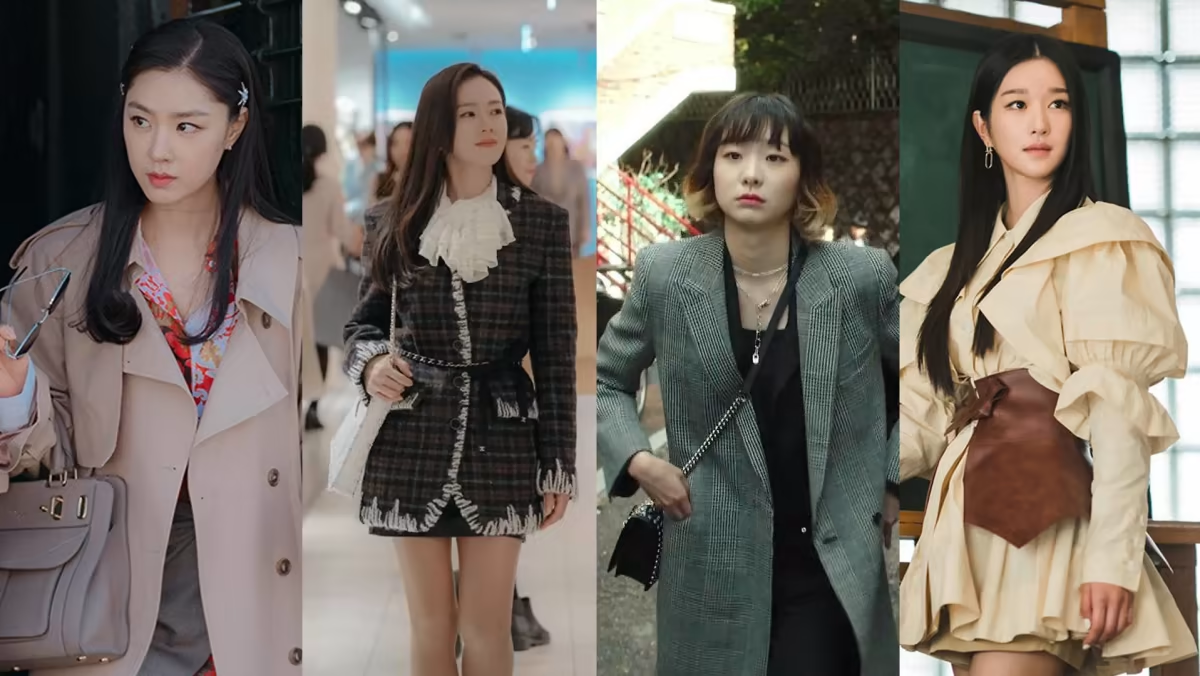
The influence of K-dramas now extends far beyond late-night streaming sessions.
They’ve quietly become mood boards for how a new generation dresses, talks, and even expresses emotion. What once began as scripted romance and drama has evolved into a lifestyle blueprint — one that reshapes how millions interpret modern love, friendship, and self-image.
This isn’t just entertainment. It’s soft power in motion — subtle, aesthetic, and deeply human.
Fashion as Emotional Storytelling
K-dramas are masters of visual mood.
Outfits aren’t chosen merely for style; they’re coded with emotional subtext. A crisp white blouse in Crash Landing on You signals restraint and purity; a worn sweater in My Mister speaks of fatigue and quiet strength.
This visual language has made its way into wardrobes across the world.
Viewers aren’t just copying looks — they’re borrowing feelings. A muted beige coat becomes shorthand for emotional steadiness. A pastel cardigan, for vulnerability.
Through K-dramas, fashion becomes something gentler than trend: it’s a mirror of emotional honesty.
The Rise of “Soft Communication”
Another subtle shift K-dramas inspire is how people communicate — both on-screen and off.
Unlike Western media that often prizes bluntness, Korean storytelling thrives on implication. Silences, glances, and pauses carry more weight than words.
That restraint has become a form of cultural charm. Viewers start mimicking it — not consciously, but emotionally.
The idea that you don’t always need to fill the air with words feels liberating.
On social media, this translates to minimalist captions, understated emojis, or the famous “ㅠㅠ” and “ㅎㅎ” — gentle cues of emotion rather than declarations.
It’s soft communication: expressive, but never loud.
Redefining Romance: The “Slow Burn” Generation
K-dramas reintroduced patience into the vocabulary of love.
In an era of fast swipes and instant messaging, they romanticize waiting — not as passivity, but as presence.
The slow burn romance has become a counterculture movement of its own.
Couples who meet through fandoms or discussion groups often describe relationships that evolve like a 16-episode arc — emotional before physical, layered before defined.
This isn’t naïveté; it’s an alternative model of intimacy that values emotional literacy.
And it’s reshaping how many young people approach affection: not as transaction, but as tenderness.
Emotional Vocabulary, K-Style

Perhaps the most powerful export of K-dramas isn’t fashion or slang, but emotional fluency.
Words like healing (힐링) and han (한, a uniquely Korean sense of sorrow and perseverance) have entered international conversation.
Audiences now talk about “comfort dramas” the way one might describe comfort food — as emotional care.
These dramas validate melancholy, forgiveness, and quiet resilience, making it socially acceptable to feel deeply without apology.
It’s not an overstatement to say that K-dramas have normalized vulnerability.
They’ve made tenderness aspirational.
The Café Culture Connection
Walk into any café in Seoul — or in Bangkok, Singapore, or LA’s Koreatown — and you’ll see how K-drama aesthetics translate into real life.
Soft lighting, neutral tones, handwritten menus — the ambience of emotional reflection.
These spaces echo the dramas’ quiet moments: where confessions are whispered over coffee, or characters pause to think under soft light.
In that sense, the K-drama universe has leaked into daily architecture. We’re not just watching comfort; we’re building it around us.
Beyond Screens: The Emotional Economy
The success of K-dramas has birthed what could be called an emotional economy.
Viewers don’t only consume stories — they internalize them, then express that feeling through shopping, playlists, travel, and digital communities.
Merch isn’t just memorabilia; it’s a continuation of emotional investment.
When someone buys a coat like Yoon Se-ri’s or visits a filming location, they’re not chasing celebrity — they’re chasing a memory that feels personal.
That’s cultural impact at its most intimate: where emotion turns into identity.
Closing Thought
K-dramas might look like escapism, but their real magic lies in reflection.
They let us rehearse emotions we struggle to express in real life — love, regret, resilience — in a safe, beautiful frame.
So when people say, “It’s just a show,” they miss the point.
It’s not just a show; it’s a language of feeling.
And increasingly, it’s how a generation has learned to be human — softly, stylishly, and sincerely.
